
EN 388 Cut Level Guide: How to Read Glove Ratings
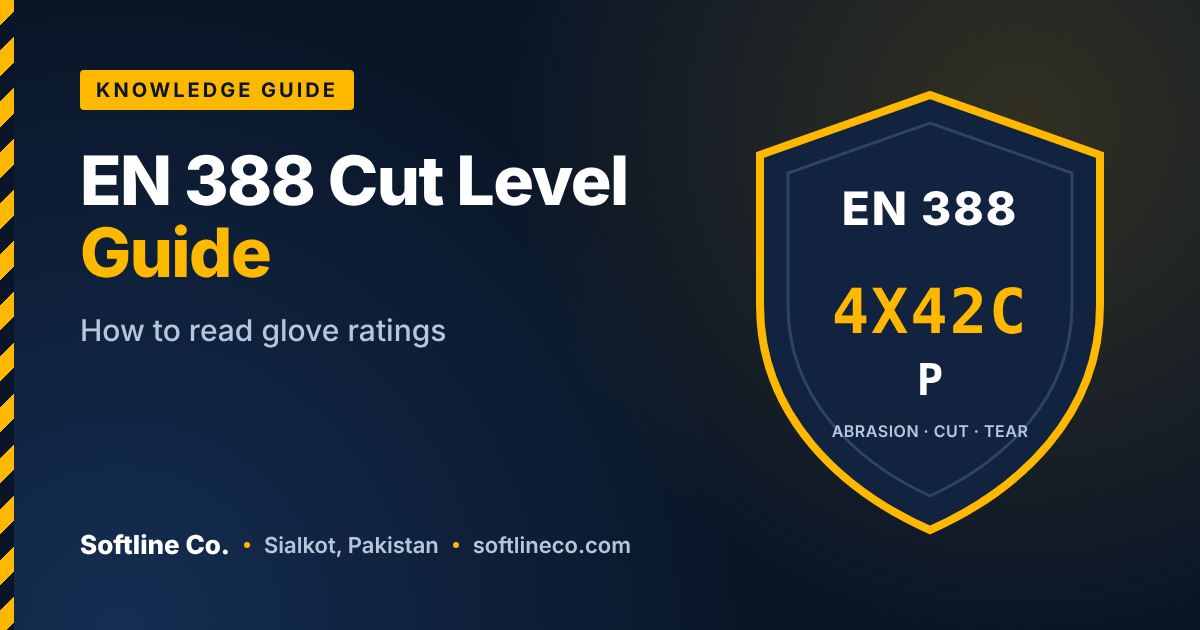
If you buy work gloves for resale or for a workforce, EN 388 is the rating you will see on almost every label. It covers protection against mechanical risks, and the current version is EN 388:2016+A1:2018. A marking such as 4X42C P looks like a code, but it is easy to read once you know what each position means.
How to read the marking
The marking is made of four digits followed by one or two letters. The first digit is abrasion resistance, scored from 0 to 4. The second digit is the blade cut test, called the coup test, scored from 0 to 5. The third digit is tear resistance, from 0 to 4, and the fourth is puncture resistance, from 0 to 4. The first letter is the cut resistance result from the ISO 13997 TDM test, rated A to F. If there is a second letter, P means the glove passed the impact protection test. A higher number is always better, and an X means that test was not done or does not apply. So in 4X42C P, the glove scored 4 for abrasion, was not tested in the coup test, scored 4 for tear and 2 for puncture, reached cut level C, and passed impact protection.
Cut level: the part buyers mix up
EN 388 has two separate cut tests. The coup test gives the second digit. The TDM test gives the letter, which shows the force in newtons needed to cut through the glove: A is 2 N, B is 5 N, C is 10 N, D is 15 N, E is 22 N and F is 30 N. Highly cut-resistant fibres can dull the blade in the coup test, so when a glove has a letter, that letter is the more reliable cut figure.
Be careful with the phrase “cut level 5”. It can mean level 5 on the EN 388 coup test, or level A5 on the separate US ANSI/ISEA 105 scale, which runs from A1 to A9. The two scales are not directly comparable, so always ask which standard a supplier is talking about.
Choosing the right level
Sheet metal, glass and other sharp-edged parts call for a higher cut rating, but the right level depends on the risk assessment of your end customer. Higher cut resistance can also mean less dexterity and comfort, so choose the lowest level that covers the real hazard.
Buying tips
Always ask for the full marking and the test report, not just “level 5”. Check that the marking is printed on the glove and on the packaging. Also remember that materials such as HPPE, glass fibre and steel blends reach cut levels in different ways, which you can read about in our material guide.
Need cut-resistant gloves to a specific EN 388 rating? Send us your target rating, quantity and branding through our contact page and we will come back with samples and next steps.